.jpg)
Although the survey pointed to the softness in demand leveling off, a complete recovery is still some way off.

India's services sector activity continued to expand in September, supported by favourable underlying demand amid the easing of COVID-19 restrictions, but lost some momentum from August's 18-month high level, a monthly survey said on Tuesday. The seasonally adjusted India Services Business Activity Index fell from 56.7 in August to 55.2 in September, but remained well above its long-run average. "Despite easing from August, the rate of expansion was marked and the second-fastest since February 2020," the survey said.
India's services sector activity moderated further in January as new business rose at a noticeably slower rate amid the escalation of the pandemic, reintroduction of restrictions and inflationary pressures, a monthly survey said on Thursday. The seasonally adjusted India Services Business Activity Index fell to 51.5 in January, down from 55.5 in December, pointing to the slowest rate of expansion in the current six-month sequence of growth. For the sixth straight month, the services sector witnessed an expansion in output.

The seasonally adjusted India Services Business Activity Index rose from 45.4 in July to 56.7 in August, as the reopening of several establishments and increased consumer footfall boosted sales. The services sector witnessed the first expansion in output in four months and a rebound in business confidence.
India's services sector activities contracted further in June as the intensification of the COVID-19 crisis and reintroduction of containment measures restricted demand, a monthly survey said on Monday. The seasonally adjusted India Services Business Activity Index fell from 46.4 in May to 41.2 in June, as new work intakes and output contracted at the fastest rates since July 2020, which prompted companies to reduce employment again. Subdued demand conditions resulted in a second successive monthly drop in new business received by services firms.
The RBI left interest rates unchanged, saying there was no substantial development on inflation or fiscal fronts to warrant a fresh reduction.
India's services sector activities eased to a three-month low in April, as the rise in business activity was constrained by the pandemic and sentiment towards growth prospects faded, a monthly survey said on Wednesday. The seasonally adjusted India Services Business Activity Index fell to 54 in April from 54.6 in March, the slowest increase in output in three months. In PMI parlance, a print above 50 means expansion while a score below 50 denotes contraction.

The HSBC Emerging Markets Index, a monthly indicator derived from the PMI surveys stood at 52.6 in March, little unchanged from the February reading when it stood at 52.4, indicating a subdued rate of economic growth in global emerging markets.
India's services sector activity expanded at the second-fastest pace in more than a decade during November, driven by sustained rise in new work and improvement in market conditions, a monthly survey said on Friday. The seasonally adjusted India Services Business Activity Index was at 58.1 in November, fractionally down from 58.4 in October. The November figure points to the second-fastest rise in output since July 2011. For the fourth straight month, the services sector witnessed an expansion in output.

The upcoming corporate results season and the approaching Union Budget kept investors on their toes

The growth was primarily driven by domestic investments, which accounted for 60 per cent of the total inflows during the first quarter of the financial year.

The HSBC Emerging Markets Index, a monthly indicator derived from the PMI surveys, remained only just above the neutral threshold of 50.0 in September, signalling muted output growth in emerging markets.

Indian service sector output broadly stabilised in September but remained in the contraction zone as incoming new business fell moderately due to the damaging impact of the pandemic on demand, leading to more job losses.

India's services sector activity moderated in December as business activity and sales rose at a softer pace, while price pressures and the possibility of new waves of Covid-19 affected business sentiment, a monthly survey said on Wednesday. The seasonally adjusted India Services Business Activity Index fell from 58.1 in November to a three-month low of 55.5 in December. The rates of expansion moderated but were nevertheless "marked" by historical standards, the survey said.
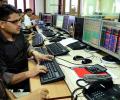
From the Sensex basket, Power Grid, Asian Paints, Tata Motors, Tata Steel, NTPC, Sun Pharma, Mahindra & Mahindra, HDFC Bank, Tata Consultancy Services and JSW Steel were among the major gainers. Kotak Mahindra Bank, Bharti Airtel, Axis Bank, Wipro, ICICI Bank and IndusInd Bank were among the laggards.

RBI interest rate decision, macroeconomic data and global trends would guide markets' movement this week, analysts said. Besides, trading activity of foreign investors and the last batch of Q1 earnings announcements would also guide trends in equities. HSBC PMI (Purchasing Managers' Index) for the services sector is scheduled to be announced on Monday.

Macroeconomic data announcement, Omicron situation and global trends will be the major driving factors for the equity market in the first week of the new year 2022, according to analysts. In what turned out to be a historic year, the Indian stock indices went past multiple milestones and the 30-share Sensex made an annual gain of 10,502.49 points or 21.99 per cent in 2021. Religare Broking Vice-President (Research) Ajit Mishra said, "This week marks the beginning of a new month and participants will be closely eyeing some crucial high-frequency data like monthly auto sales, India manufacturing PMI and India services PMI. "Besides, updates on the COVID-19 situation and performance of global markets will also be critical."

Days before Diwali, the monthly economic review by the finance ministry has highlighted moderation in urban demand, softening consumer sentiments and limited footfall as areas that need to be watched. In its review, released on Monday, the ministry also noted the early signs of artificial intelligence displacing workers, as described in anecdotal reports. The commentary from several large consumer goods companies, including Nestl India, Hindustan Unilever, and ITC, in their recent quarterly earnings, has been around a sluggish urban demand. Rural consumption, however, has mostly seen a revival, the companies pointed out.

Equity investors will track the trading activity of foreign investors, global trends and ongoing earnings results for further cues, and benchmark indices may continue to witness consolidation in a holiday-shortened week amid the monthly derivatives expiry, analysts said. Markets fell sharply last week amid massive foreign capital outflows and dismal Q2 earnings so far. Weakness in the markets might continue in the near term amid cautiousness among investors ahead of the US presidential election early next month, an expert said.
India was already in the midst of a protracted economic slowdown before the virus hit due to a festering crisis among shadow lenders and declining consumer demand and private investment. Service sector activity in India is still effectively on hold.
India's services sector activity expanded at the strongest pace in ten-and-a-half years in October, driven by a substantial upturn in business activity amid favourable demand conditions, a monthly survey said on Wednesday. Companies indicated that a notable pick-up in new business led to the fastest expansion in output in over a decade and as a result more jobs were created, even though business confidence remained subdued due to growing inflationary concerns. The seasonally adjusted India Services Business Activity Index rose from 55.2 in September to 58.4 in October, signalling the strongest rate of growth in ten-and-a-half years.

Broadly stagnant sales causes the first drop in business activity in over a year.
.jpg)
The HSBC Emerging Markets Index, a monthly indicator derived from the PMI surveys, continued its upward trajectory in November on the back of faster manufacturing growth.
The headline seasonally adjusted Nikkei India Composite PMI Output Index, that maps both the manufacturing and services sectors, rose from 53.3 in June to 54.1 in July.
India's services sector activities eased in March as growth was hit by the detrimental impact of the coronavirus pandemic and input costs remained elevated, a monthly survey said on Wednesday. The seasonally-adjusted India Services Business Activity Index fell from 55.3 in February to 54.6 in March. Though the rates of expansion softened, it indicated growth for the sixth consecutive month. In PMI parlance, a print above 50 means expansion while a score below 50 denotes contraction.

Wipro's ServiceNXT Operations framework will be utilised to manage PMI's technology and applications infrastructure.
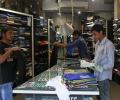
Firms said subdued demand conditions, unfair pricing among competitors and economic woes affected the sector.

Create a balanced schedule that allocates time for both studies and skill development, suggests rediffGURU Aasif Ahmed Khan.


The 30- Share BSE Sensex ended 19924 up 22 points or 0.11 per cent, while the broader 50-share NSE Nifty closed down by 2 points or 0.01 pct at 5907.

Services companies reported an increase in new work intakes, which they attributed to successful marketing efforts and strengthening demand.

The IHS Markit India Services Business Activity Index stood at 5.4 in April, an extreme decline from 49.3 in March, and indicative of the most severe contraction in services output since records began in December 2005. As per the IHS Markit India Services Purchasing Managers' Index (PMI), a print above 50 means expansion, while a score below that denotes contraction.
The 30-share Sensex ended down 64 points at 20,787 and the 50-share Nifty ended down 20 points at 6,192.
The 30-share Sensex ended down 64 points at 20,787 and the 50-share Nifty ended down 20 points at 6,192.

The Reserve Bank of India's (RBI's) State of the Economy report for October acknowledged a slowdown in some high-frequency indicators but expressed confidence in a recovery, aided by consumption demand during the festival season. "In India, aggregate demand is poised to shrug off the temporary slowdown in momentum in the second quarter of 2024-25 as festival demand picks up pace and consumer confidence improves," said the report released on Monday.

Among the Sensex firms, JSW Steel, Tata Steel, Tech Mahindra, Infosys, Wipro, Tata Consultancy Services, Nestle, HCL Technologies, HDFC Bank and Maruti were the major laggards. IndusInd Bank, ITC, Bharti Airtel and State Bank of India were among the winners.
The Fed interest rate decision, domestic macroeconomic data announcements and quarterly earnings will be the major sentiment drivers for the equity market in a holiday-shortened week ahead, analysts said. Investors will also take cues from the monthly auto sales numbers to be announced on Monday. Equity markets will remain closed on Thursday for Diwali Laxmi Pujan and on Friday for Diwali Balipratipada.

FY22 will be the year to rebuild with the IMF projecting output growth at 11.5 per cent, economic survey at 11.0 per cent and the RBI's Monetary Policy Committee at 10.5 per cent.

The ongoing fourth quarter earnings season, global factors and macroeconomic data would guide the trends in the equity markets this week, analysts said. Markets would also take cues from trading activity of foreign investors, rupee-dollar trend and movement of global oil benchmark Brent crude. "Domestically, the next batch of Q4 earnings reports will drive stock-specific movements, Hero MotoCorp, Larsen & Toubro, BPCL, State Bank of India, Eicher Motors and Tata Motors are some of the big names in the list and the next phase of voting," said Pravesh Gour, senior technical analyst, Swastika Investmart Ltd.

The seasonally adjusted India Services Business Activity Index rose sharply from 34.2 in July to 41.8 in August, the highest since March, before the escalation of the pandemic.
